How Similar Is Dolphin Language to Human Language?

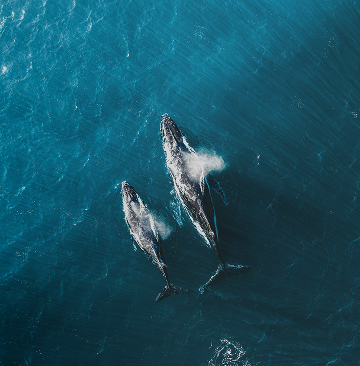
Two bottlenose dolphins skimming the surface of the ocean
Image Credit: Jonas Von Werne/Unsplash.com

Dolphins capture the human imagination in a unique way. Playful and curious, these aquatic mammals have forged fascinating relationships with humans over the years, whether they’re approaching divers in the wild, surfing in the waves, or fishing cooperatively with local fishermen. These playful animals seem just as interested in us as we are in them. 

Given the mutual curiosity, it seems possible that we might one day learn to communicate with our marine friends directly. Dolphins utilize a complex system of vocalizations to “speak” with each other. But is this system comparable to human language? And if so, how far off are we from true inter-species communication?

What Is Language?

Image Credit: Jeremy Bishop/Unsplash.com

Let’s start with the fundamentals. There are several design features that separate language from other communication systems like kinesics (body language) or artifacts (clothing). True languages are composed of individual, repeatable units – words – that can be arranged into infinite patterns – sentences. And each pattern needs to mean something, representing a specific thought that either corresponds to something happening in real time, or to an abstract idea (i.e., past or future events). 

This means that your dog’s barks and growls do not technically count as language, even when they’re whimpering to get more treats. It’s not that animals don’t think – there are many examples of animals using human language to communicate with us. Koko the gorilla is one of the more famous examples who captivated the world with her advanced understanding of sign language. Then there’s Alex, the African grey parrot who seemed to understand the meaning of 100 English words. And captive dolphins have been trained to use computer-generated whistles to communicate with humans.  

But what’s going on in the wild? Scientists have been debating whether dolphin vocalizations are a true language for decades. Are dolphins gossiping with each other through those clicks and whistles?

Translating “Dolphinese”

Image Credit: Steven Van Elk/ Unsplash.com

Marine biologists from the University of Sassari have discovered that dolphin vocalizations change from region to region, likely due to environmental factors. One pod of bottlenose dolphins living in a seagrass ecosystem had a different “accent” than another population of the same species where the ocean floor was muddy.

If that’s not enough to convince you of their language, consider that every individual dolphin has its own unique signature whistle, which essentially functions as a name they use to announce themselves. These signature whistles have been studied for decades, because they may be the greatest evidence for dolphin language. Each whistle is a distinct unit of sound – the equivalent of a word – that has a specific meaning, corresponding to an individual animal. 

Needless to say, scientists have been racing to prove the existence of “dolphinese” for decades. In 2016, Dr. Vyacheslav Ryabov, a Russian marine biologist, published a paper about two dolphins chattering in a distinctive pattern. One animal would vocalize, while the other waited patiently, without interrupting, before responding. The exchange was very similar to the cadence of human speech.

More recently, a research team from the Woods Hole Oceanographic Institute has been making waves after identifying a unique alarm phoneme, or word, used by a pod of dolphins in Florida. Each time a dolphin used the “word” for alarm, other members of its pod responded with a query call. It was as if one dolphin said, “Danger!” and others replied, “Where?” If the researchers are decoding these exchanges correctly, it is a strong case for classifying dolphinese as a true language. 

An Ongoing Conversation

Image Credit: Maria Bourgali/Unsplash.com

After years of research, scientists still don’t have a definitive answer as to whether or not dolphins use true language in the wild. Dr. Denise Herzing, founder of the Wild Dolphin Project, is using artificial intelligence to analyze 30 years of recorded dolphin vocalizations in hopes of decoding dolphinese to finally understand what they’re chattering about under the waves. If she can verify that dolphins do in fact talk to one another, it will be one of the greatest zoological discoveries of all time, because it will mean that language is not uniquely human. 

Either way, dolphins are still complex, emotional creatures that have captivated us for millennia. We have plenty in common with our oceanic friends, without ever sharing a word.