Why Do Deep-Sea Fish Look So Scary?
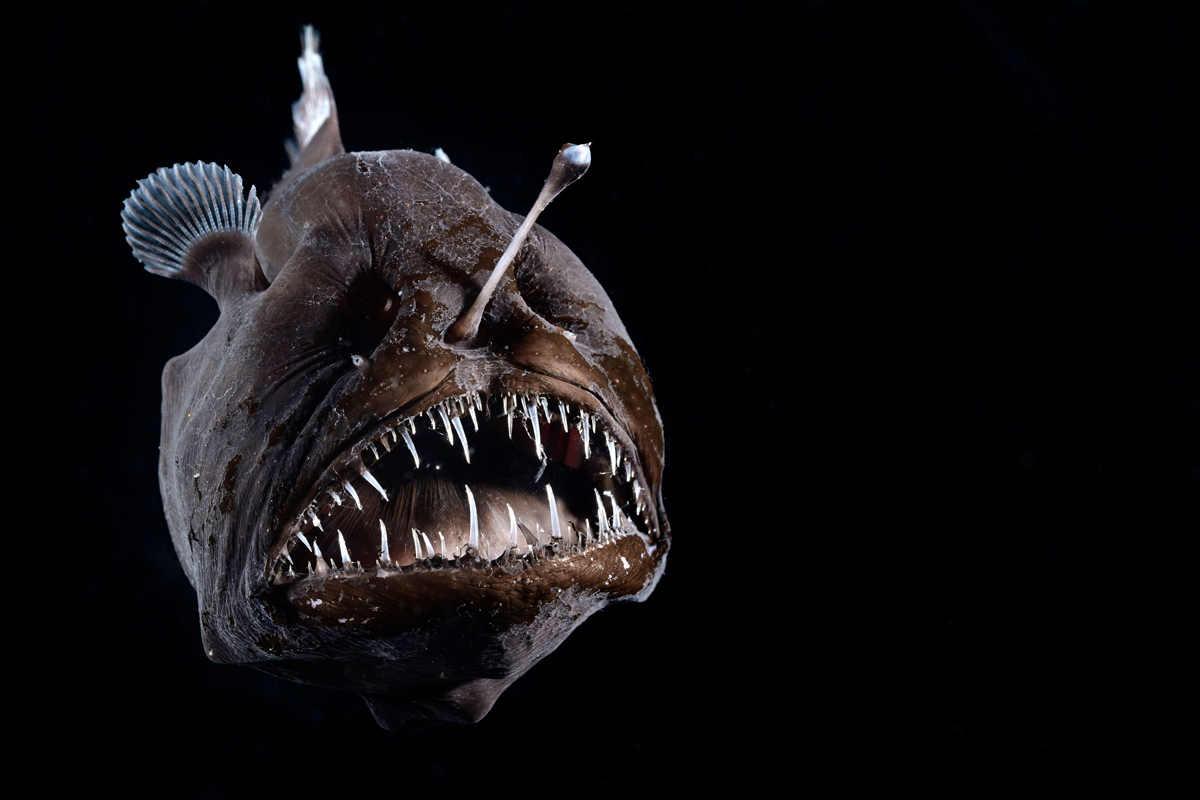

Thousands of feet beneath the ocean’s surface, sunlight disappears, pressure becomes crushing, and strange creatures drift through permanent darkness. Among them are some of the most unusual-looking animals on Earth — fish with enormous teeth, glowing bodies, oversized eyes, and faces straight out of a science fiction movie.
Those unusual — and even frightening — features are the result of millions of years of evolution in one of the planet’s harshest environments. In the deep ocean, every adaptation, no matter how unappealing, helps an animal survive. And a giant mouth, a glowing lure, or a strangely shaped body can make the difference between catching a meal and going hungry.
These creatures may not be entering beauty pageants anytime soon, but why do many of those adaptations look like pure nightmare fuel?
Deep Ocean Life Is a Constant Battle
The deep sea begins about 660 feet below the ocean’s surface, where sunlight rapidly fades. Yet many of the strangest fish you’ll find in the sea spend their lives 3,300 to 13,000 feet below the waves — deep enough to fit three to 10 Empire State Buildings between them and the surface. There, temperatures hover just above freezing, the pressure is hundreds of times greater than at sea level, food is scarce, and sunlight is completely absent.
Unlike the sunny ocean surface above, the deep sea has little or no photosynthesis, so almost no food (in the form of aquatic plants or microorganisms) is produced there. Most animals survive on a slow rain of dead plankton, waste, and other organic matter that drifts down from the surface — sometimes called “marine snow” — while others hunt the creatures around them. In a place where every meal is hard to find, wasting an opportunity to eat can mean starvation.
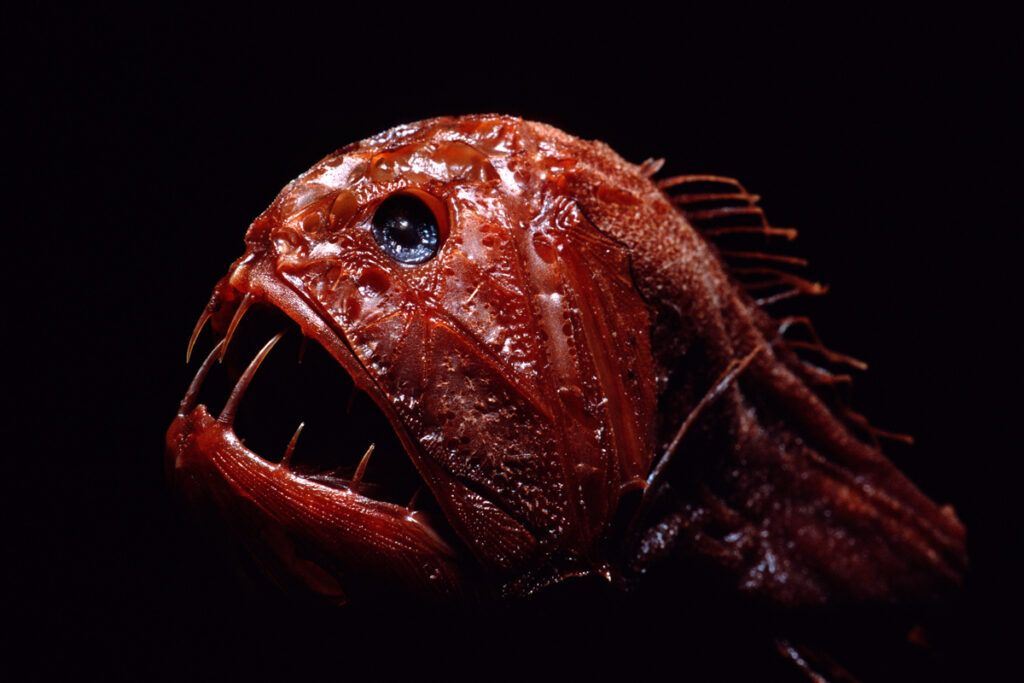
That harsh environment has shaped some of Earth’s most unusual fish specifically evolved to be expert predators. Many have enormous mouths that allow them to swallow prey nearly as large as themselves, while others have long, needlelike teeth that prevent struggling prey from escaping.
For instance, the fangtooth fish, despite growing to only about 6 inches long, has the largest teeth relative to body size of any known marine fish. The equally intimidating viperfish uses long, outward-pointing teeth and a flexible jaw to snatch prey in the darkness, while the gulper eel relies on an enormous expandable mouth to engulf surprisingly large meals.
Seeing in the Dark
Light is almost nonexistent in the deep ocean, but that doesn’t mean vision is unimportant. Many species have evolved exceptionally large, light-sensitive eyes that can detect the faint glow of bioluminescent organisms or the silhouettes of prey swimming overhead. Fish such as the telescopefish use their oversized eyes to take advantage of every available photon.
The Mariana snailfish, one of the deepest-living fish ever discovered, survives at 27,000 feet below the surface, where it relies less on sight and more on other senses to navigate and find food. In such an extreme environment, evolution favors whatever works best — not necessarily the features we may expect. Rather than large eyes, it has tiny eyes and a pale, translucent body with specialized sensory cells that help it detect vibrations and movement in the perpetual darkness.
Many deep-sea fish also produce their own light through a process called bioluminescence. Specialized organs create light through chemical reactions, allowing fish to communicate, attract mates, lure prey, or even hide. Some species use a technique called counterillumination, producing light on their undersides to match the faint light filtering down from above, making them harder for predators below to see.
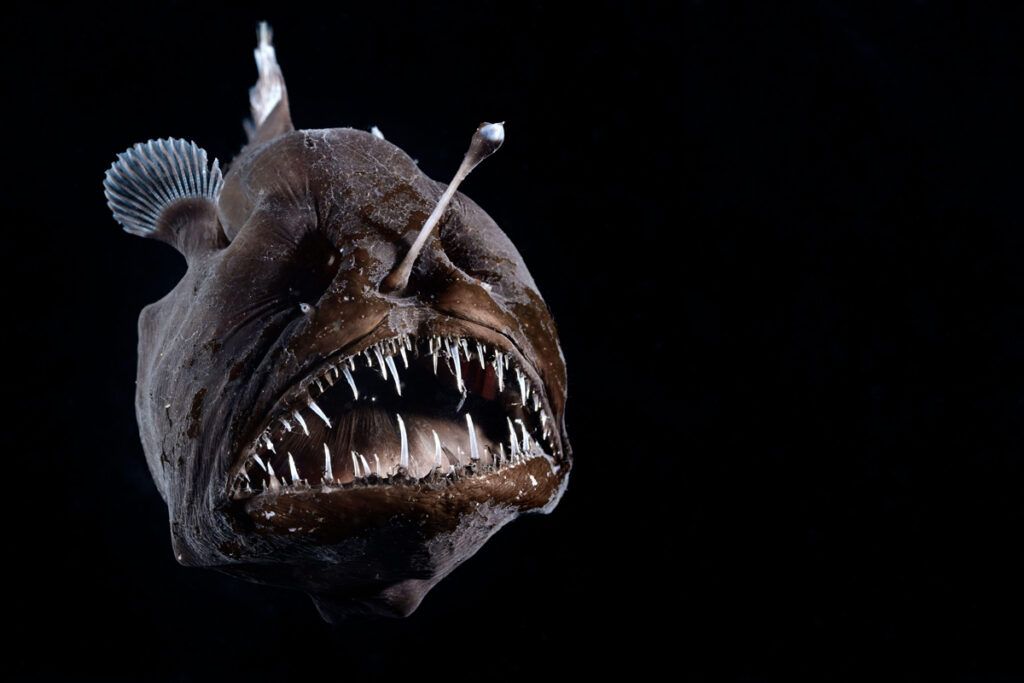
The anglerfish is likely the best-known example of bioluminescence. A glowing lure extending from its head acts like bait, attracting curious prey close enough to seize. Other fish, including dragonfish and lanternfish, produce light from rows of organs along their bodies, each using bioluminescence in different ways depending on how it hunts or avoids predators.
Built for Extreme Conditions
The deep ocean has shaped more than just teeth and eyes. Many fish have unusual-shaped bodies that are adapted to immense pressure and limited food. Some have soft skeletons and gelatinous tissues that require less energy to maintain, while others are nearly transparent, making them difficult for predators to spot.
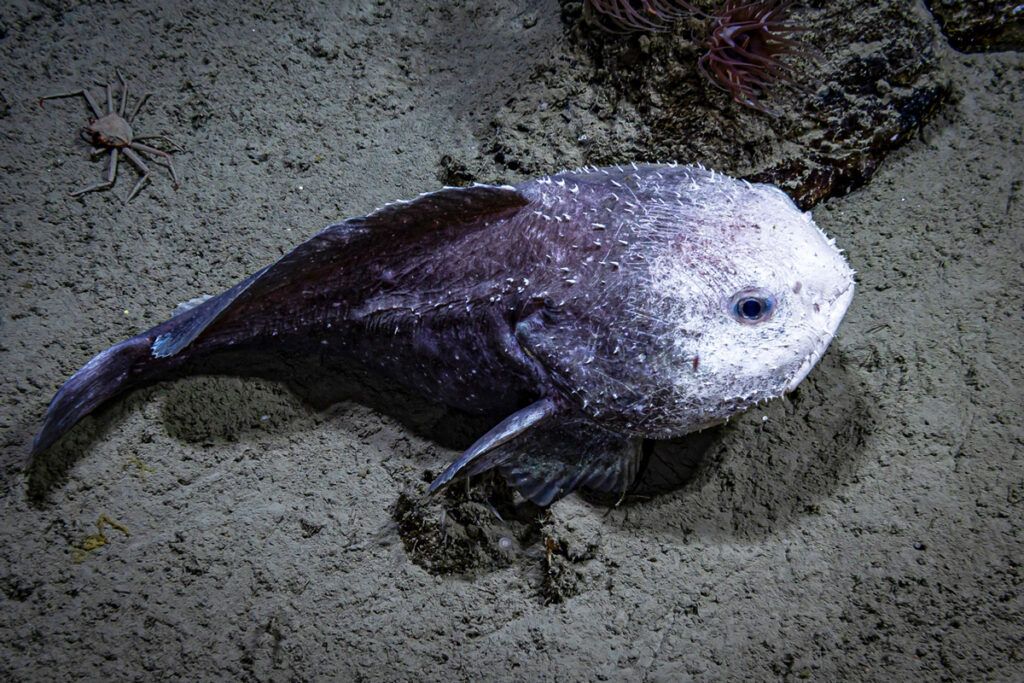
The blobfish is one of the best-known examples, although its reputation is somewhat misleading. At the depths where it naturally lives, the immense water pressure supports its gelatinous body, giving it a much more typical fish-like appearance. The drooping, misshapen blob you may have seen in photographs is the result of being brought rapidly to the surface, where the dramatic drop in pressure causes its body to lose its natural shape.
The deep sea is one of the most unforgiving places on Earth. The oversized jaws, needlelike teeth, glowing lures, and unusual body shapes produced in those surroundings can seem monstrous to our human eyes. But what may look like the stuff of nightmares is actually an impressive collection of adaptations perfectly suited to life in an extreme and relentless environment.