5 Animals That Are Essentially Invisible
Evolution is an endlessly innovative process. While predators develop sharper senses and more effective ways to detect their targets, their prey develop better ways to hide. Over millions of years, this back-and-forth has produced some of the most extraordinary adaptations in the natural world — including animals seemingly capable of vanishing in plain sight, outwitting eyes far keener than our own.
Scientists call this ability crypsis, or the ability to deploy camouflage using strategies such as background matching, disruptive coloration, and masquerading as inedible objects. The most accomplished masters of disguise are so adept at disappearing that, in some cases, they not only fool their predators, but trained biologists as well. Here are five creatures so good at hiding that they’re essentially invisible.

Leaf-Tailed Geckos
Found in the rainforests of Madagascar, leaf-tailed geckos are widely regarded as some of the most perfectly camouflaged animals ever documented. In 1989, only six species of leaf-tailed geckos were known to exist, but 22 have been recorded as of 2026, with more yet to be discovered — a testament to how tricky it is to actually spot these crafty nocturnal lizards.
These geckos have bark-like skin, flattened tails, and skin flaps surrounding their whole body and head — the edges fringed with dermal flaps that eliminate shadows — all of which combine to give the animals no visible silhouette at all. During the day, they press themselves flat against bark or among leaf litter and remain still, perfectly blending into their environment. Even experienced naturalists struggle to detect them when standing mere feet away.

Pygmy Seahorses
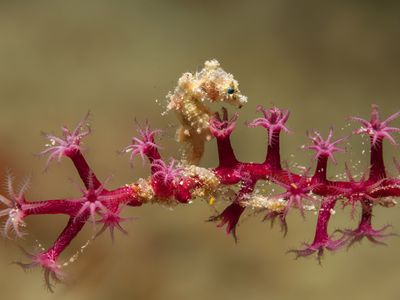
Pygmy seahorses exclusively inhabit specific species of fan coral in the Western Pacific Ocean. As the smallest seahorse species in the world, measuring less than the length of a thumbnail, they’re already hard to spot — but they also have an uncanny ability to blend in with the coral they call home.
Their bodies are covered in rounded tubercles that replicate the exact texture and color of said coral. When they attach themselves to the coral with their tails, they look just like extensions of the branching fans. The match is so precise that the species was only discovered by accident in 1969 when a coral sample was brought into a laboratory and examined under magnification — at which point a scientist noticed the attached seahorse.

Gaboon Vipers
If you’re scared of snakes, brace yourself: The Gaboon viper possesses the longest fangs of any venomous snake, has the highest venom yield per bite, and is the heaviest venomous snake in Africa. As if that wasn’t enough, it’s also adorned with a strikingly elaborate geometric pattern of diamonds and stripes that — while dramatic and ornamental in the open — renders it basically invisible when resting motionless among dry leaves on the forest floors of sub-Saharan Africa.
The pattern is one of the most sophisticated examples of disruptive camouflage in the animal kingdom, breaking up the snake’s outline so completely that it ceases to look like a living thing.

Stonefish
The stonefish is both the world’s most venomous fish and one of its most perfectly camouflaged — a chilling combination. These ambush predators rest motionless on the seafloor or among rocks and coral, where they become practically indistinguishable from the surrounding environment.
The stonefish’s warty, irregular skin matches the encrusted rock so precisely that it can sit in shallow water just inches from potential prey or predators — or a swimmer’s foot — without detection. They possess up to 15 dorsal spines, capable of delivering venom that causes excruciating pain. Stonefish venom can be deadly to humans, but fatalities are rare.

Cuttlefish
The cuttlefish is one of the most intelligent invertebrates in the world, with levels of self-control comparable to that of primates. It also has one of the most sophisticated camouflage systems in the known animal kingdom.
Like its close relation the octopus, the cuttlefish gets its incredible camouflage abilities from cells called chromatophores that extend all across its skin. It controls up to 10 million of these pigment-containing cells, allowing it to change its color and surface texture in less than a second. These amazing cephalopods can also change the physical texture of their skin to match the surrounding rocks, coral, or seaweed, enhancing one of the most effective invisibility cloaks in nature.